

Danica’s interest in understanding why people behave the way they do, combined with a passion for environmental sustainability, led to research exploring how pro-environmental interventions can be designed, implemented and rigorously evaluated to support long-term behaviour change.
Summary of Master of Research thesis: Sustained pro-environmental behaviour change in households
Background and Aims
Danica’s research addressed a gap in behaviour change evidence by measuring behaviour pre- and post-intervention and following participants over time to determine whether changes lasted.
Using household food waste as the applied context, the research aimed to design, implement and evaluate interventions that could influence relevant behaviours, reduce food waste and support lasting change.
Method
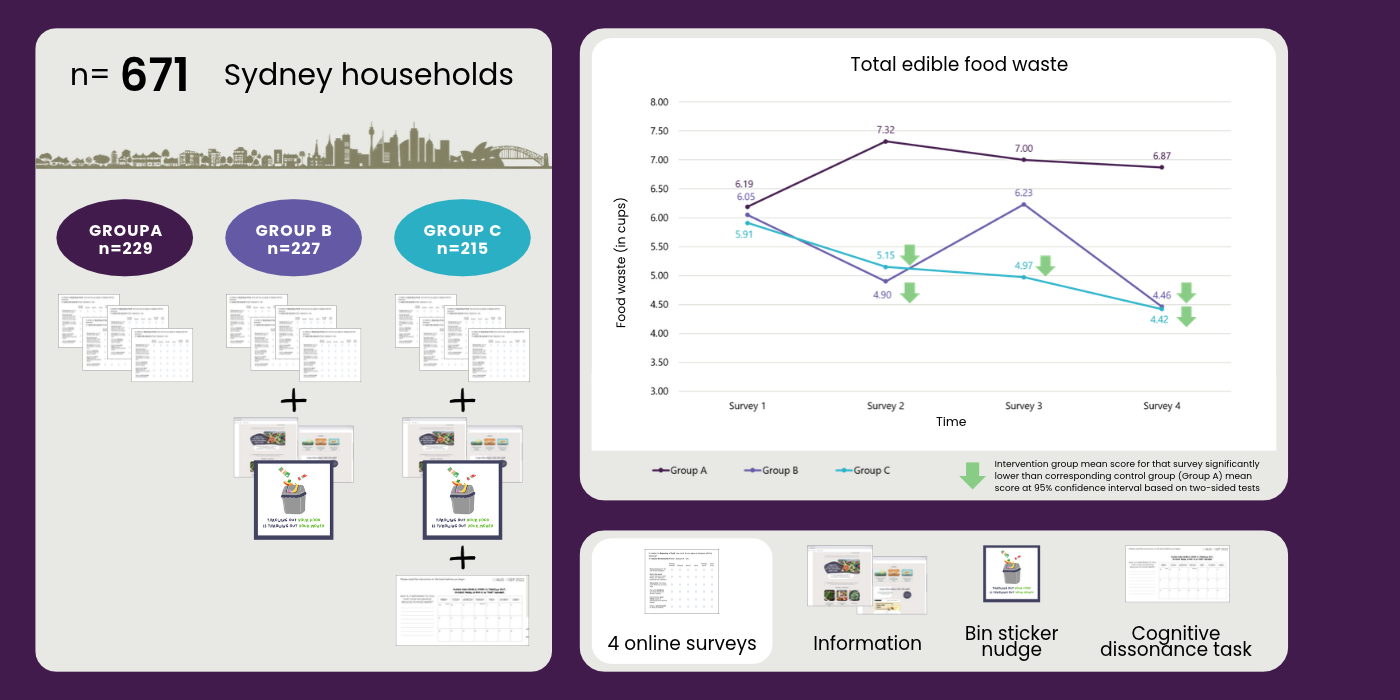
The primary research involved a seven-month randomised controlled trial with 671 households across Greater Sydney.
Households were randomly allocated to a control group or one of the intervention groups. Data were collected pre-intervention, immediately post-intervention, and at two later follow-up points. This design made it possible to assess not only whether the interventions produced change in the short term, but whether those changes remained over time.
Danica designed the behaviour change interventions based on previous research into household food waste and established behaviour change approaches, including information and awareness, nudging and cognitive dissonance. The intervention messaging also drew on previous research identifying saving money as a particularly strong motivator for reducing household food waste.
Key Findings
Significant reductions in self-reported food waste were still evident seven months after the intervention in both intervention groups, a pattern not observed in the control group.
The interventions were most effective among households reporting higher levels of food waste at baseline.
No single behaviour leads to household food waste. The research supports addressing multiple food-management behaviours together to drive change.
Conclusions
The research shows that well-designed behaviour change interventions can reduce household food waste and that these changes can last.
The stronger effects among higher food wasters reinforce the importance of segmentation and recognising differences between audiences when designing and evaluating behaviour change initiatives. The findings also support approaches that address multiple behaviours rather than looking for a single behaviour or intervention to drive change.
The study achieved strong participant retention, reflecting deliberate planning and considerate communications throughout the longitudinal research. Of the 671 households recruited, 92% completed the full study, providing a robust basis for assessing change.
More broadly, the thesis contributes practical evidence for researchers, practitioners and policymakers seeking to design and evaluate pro-environmental interventions capable of creating meaningful long-term change.
Danica’s research also complements Instinct & Reason’s work for the Fight Food Waste CRC and NSW EPA, bringing together academic and applied experience in understanding household behaviour and informing the design and evaluation of behaviour change initiatives.
References
Jobson, D., Nabi, N., Karunasena, G. G., Pearson, D. H., & Dunstan, E. (2025). “Throwing out your food is throwing out your money”: Measuring the impact and longevity of interventions on food waste in households. Resources, Conservation and Recycling, 218, 108222.
Jobson, D., Karunasena, G. G., Nabi, N., Pearson, D., & Dunstan, E. (2024). A systematic review of pre-post studies testing behaviour change interventions to reduce consumer food waste in the household. Sustainability, 16(5), 1963.
Jobson, D. (2025). Breaking the Mould: Exploring behaviour change interventions that lead to sustained reductions of food waste in households [Master of Research thesis, CQUniversity].
Danica completed her Master of Research (by Publication) at CQUniversity in 2025, following a Bachelor of Criminology and Criminal Justice from the University of New South Wales in 2015.
Research article – Throwing out your food: Primary Research
Links to further case studies: Click Here